
Language
“Predator and prey are different in that prey cannot afford the luxury of speech; life and survival depend on being a great silent listener. “
This has always resonated with me, especially as a human being that is an Apex predator, with the presentation of prey. Prey animals are not taught language, survival is based on being a great listener, or observer. Being able to notice the comings and goings around us, the hypervigilance to sounds or motion. The tone, the vibrato. Being able to sense the slightest shift in the atmosphere or energy. These are the ways horses listen.
We need an alpha like Saint or Rocky, who are leaders, confident and brave. Rocky who keeps a watchful eye and ear on situations, ready to inform the herd if needed but without causing alarm to others prematurely. Saint tracks the comings and goings of the herd from within, tracking the shifts and settling them by telling others where to go. Both alphas do something Belle, Swayze, or Pearl cannot. They speak, listen, and watch and they pass the information to the entire herd. They tell the herd to flee, or to go back to grazing. We need these two alphas with distinct roles. We need Rocky, who orients and turns towards the external surroundings, and Saint passes the information internally and tracks the entire herd.
Without the alphas to pass the notice the external, and pass the information internally to the herd, there is no return to grazing, or rest and digest. That flow of energy, communicated through the body is language. The twitch of an ear, the wrinkle of the nose, the direction of ears is the language of horses being passed through the herd.
This is the first thing I teach people when they come to the farm, it’s the body language or language of horses. When they ask what it means when a horse stomps their legs, I teach them about the body cues, what’s happened before instead of rushing to put meaning to it. The language of horses is a flow of communication, not a story with meaning. Horses can speak if they feel safe enough, and if we listen. They can keep the conversation in a flow of back in forth, giving depth to the interactions in a way words would fall short. What horses lack in words they make up in depth.
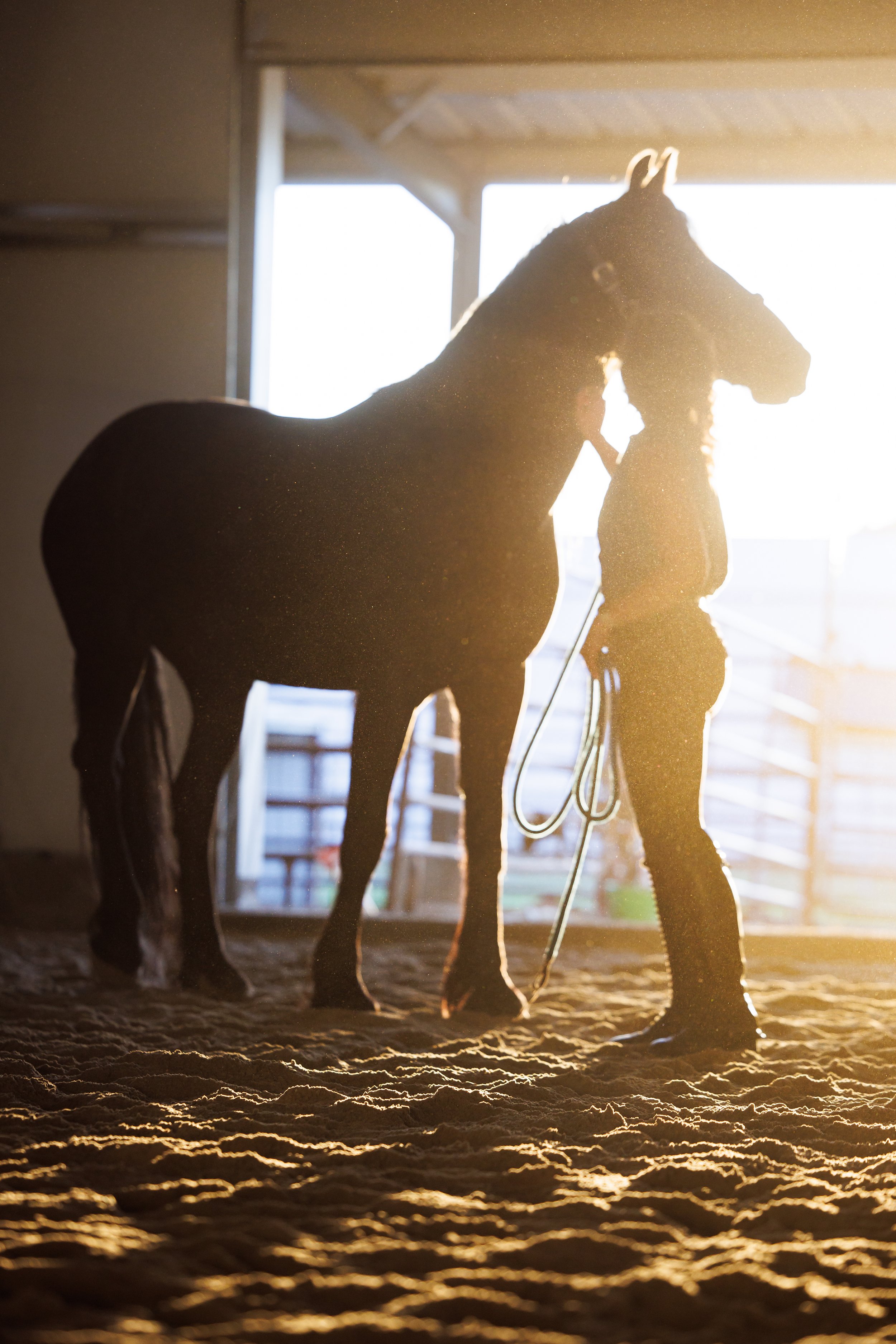
“There is a language in trauma, and it is unspoken..“
When a client doesn’t have language for their life experiences, their body tells the story.
Their words say, “it wasn’t that bad,” while their body flinches, shoulders collapse, or their throat tightens.
They say, “I don’t remember much of that time,” as their spine subtly swerves, their gaze fixes, their stomach drops, or their muscles go slack.
There is a language in trauma, and it is unspoken. But we miss it when we’re looking through the fog of our own unacknowledged dissociation. A therapist can only perceive what they’ve allowed themselves to feel. To witness another’s pain, we must first be willing to witness our own.
Our systems are tracking these micro-moments long before our minds make sense of them. And in those same micro-moments, we can lose our own alpha — our capacity to orient, to stay present, to hold steady.
To be an alpha in the therapy room is not dominance; it’s orientation.
It’s the ability to turn toward threat, uncertainty, and connection when others can’t find ground. It’s having the courage to see our own complexity, our own dissociation, our own trauma — so we don’t flinch when our clients start speaking in the body’s language.
Horses have always been called mirror and therapists are the same. We are a mirror of information, stability, and safety; and if we can’t hear it or see it, we are an incongruent predator in a small room with a person who feels like prey.
Language is more than words—it is the body, the breath, the glance that says ‘you are safe here.’ Horses teach us this, and if we listen, we can embody it too.